

raramuridesign support
Matjiesrivier Nature Reserve
Matjiesrivier Nature Reserve, proclaimed as a nature reserve in 2000 and a World Heritage Site in 2014, is situated on the drier eastern boundary of the Cederberg Mountains.
This 12 800ha reserve, formerly a productive farm, is situated in the ecotone between the Fynbos and Succulent Karoo biomes, increasing the fauna and flora diversity of the reserve along with its historic and archaeological heritage. The primary objectives of the reserve are to maintain the ecological systems & processes, specifically the ecotone process & patterns and to conserve genetic diversity and heritage of the area.
Activities at the reserve include rock art visits at the Stadsaal cave area and Truitjieskraal where you can follow a circular interpretive trail of 1.5 kilometres among the spectacular rock formations. Truitjieskraal is also famous for rock climbing.
You can get easy day access to these sites by purchasing a permit at any of the tourism offices in the Cederberg Conservancy.
Due to the cold winters the flower season at Matjiesrivier Nature Reserve and neighbouring farms last much later, usually till end October with breath-taking displays of purple vygies and yellow daisies. The diversity of the area also offers good opportunities for bird watching. Matjiesrivier Nature Reserve is home to an active breading pair of Black eagles (Aquila verreauxii) which are often seen soaring on the thermals above the reserve.
No accommodation is available at Matjiesrivier Nature Reserve.
Matjiesrivier Nature Reserve houses the Cape Leopard Trust, the offices of the Cederberg Conservancy and the Red Cederberg Karoo Park are also based here.

Khoisan Rock Art
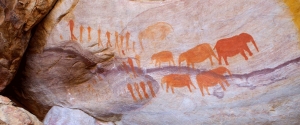
“Southern Africa probably has the richest legacy of Rock Art in the world. The Western Cape, particularly the mountainous regions from the Koue Bokkeveld, through the Cederberg to the Agter Pakhuis, may have more rock painting per square kilometre than anywhere else in Southern Africa" according to Peter Slingsby 1998.
Southern African rock art has been dated to be as old as 28 000 years, with the age of the Cederberg paintings ranging from 8 000 years to 100 or 200 years. The paintings most commonly depict animal scenes, and it is thought that particular animals such as eland, have important symbolic religious meanings. Paintings were made by the San as part of their religion and can thus not be interpreted literally.
Humans are also commonly depicted, often in procession, hunting or out gathering food. Other types of paintings show therianthropes (half-animal half-human figures) and entoptic shapes, probably of important religious meaning.
Rock art sites in the Cederberg Conservancy open to the public are Stadsaal, Truitjieskraal, Southern Arch and Varkkloof.
Further reading
- Cederberg Rock Paintings – Follow the San by John Parkington, Krakadouw Trust, 2003 ISBN 0-620-31113-4
- Some views on Rock paintings in the Cederberg by Janette Deacon, National Monuments Council, 1994 ISBN 1-875012-25-7
Geology
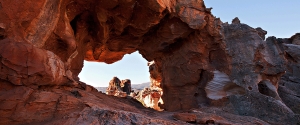
The Cederberg is famous for its spectacular rock formations that were sculpted by wind and water over many millions of years. Almost the entire area consists of sedimentary rock, sandstone and shale. According to Barnard & Greeff (1993) the Cederberg was a prominent feature since before the breaking up of Gondwanaland 130 million years (Ma) ago.
The geology of the Cederberg comprises of the Cape Supergroup (Table Mountain Group, Bokkeveld Group and Witteberg Group) and the Karoo Supergroup (Dwyka Group, Ecca Group and Beaufort Group). The Cape Supergroup was formed about 700 – 600 Ma ago by a succession of sedimentation of sandstone (silt, mud and sand). The distinct reddish colour of rock is a result of minerals like iron and manganese that formed part of the sediments.
About 330 Ma ago climatic change set in and the rapid growth of the continental ice sheets resulted in a drop in sea level which exposed the upper Witteberg Group sediments that began eroding. This process was enhanced by scouring actions of large continental glaciers moving over these exposed layers. These moving glaciers played a big role in the forming of the high mountains and deep valley landscape of the Cederberg Mountains as we know it today.
The first layer of the Karoo Supergroup was deposited over the Cape Supergroup, about 310 Ma ago when the icy conditions subsided.
Due to intercontinental movement and forces about 300 Ma ago the stratigraphy of the Cederberg shows eastward-dipping of strata of the Cape Supergroup overlain by the Karoo Supergroup (Reid et al, 2000). This can be seen in the ridges (‘riffels’) east of the road between Mount Ceder and Wupperthal.
Flora
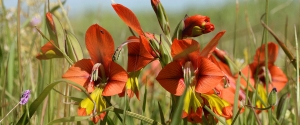
There are 34 internationally recognised biodiversity Hotspots in the world. One of them is the Cape Floral Kingdom, the smallest of the six Floral Kingdoms of the world and the only Kingdom encompassed entirely within a single country. The Cape Floral Kingdom is divided in five different vegetation types or biomes, two of these are found in the Cederberg Conservancy namely the Fynbos Biome and the Succulent Karoo Biome. The Fynbos biome is subdivided in two distinct vegetation groups, Fynbos and Renosterveld.
The vegetation of the conservancy area changes from Fynbos to Succulent Karoo as the climate and geology change from west to east, with Central Mountain Renosterveld to be found in the transition area. The Cederberg Wilderness and adjacent farms comprise of Fynbos vegetation, while vegetation in the eastern section of the Matjiesrivier Nature Reserve and adjacent farms to the east and south changes to Central Mountain Renosterveld and Succulent Karoo.
The Fynbos Biome is largely within the boundaries of the Western Cape with an estimated 9 500 species of which 70% are endemic and contained in this biome. Only 9% of this biome is formally protected.
Fynbos vegetation is largely confined to soils derived from sandstone which are well-leached, infertile soils. Fynbos is recognized by the presence of reeds (Restionaceae), ericas (Ericaceae) and many different types of Proteaceae such as sugarbush proteas, cone bushes, pincushions and spiderheads. Plants commonly seen at lower altitudes are the grey-leaved sugarbush (or suikerkan; Protea laurifolia), the spinning top (or tolletjiebos; Leucadendron rubrum), and the common sunshine conebush (or stompieknopbos; Leucadendron salignum). Waboom veld is a predominant feature of the lower slopes where the sturdy, fire-resistant wagon tree (or waboom; Protea nitida) gives an almost savannah-like appearance to the landscape. In spring bright patches of purple-blue ridderspoor (Brachy-capaea juncea) are eye-catching, as are the large yellow Clanwilliam daisies (harpuibos; Euryops speciossimus, and Sederberg-harpuis; E. wageneri).
The Cederberg Fynbos is also home to the rooibos tea plant (Aspalathus linearis) and many different types of buchu (Rutaceae) with their fragrant oils. Wild olive trees (Olea europaea subsp. africana), rockwood (or kliphout; Heeria argentea), and rock candlewood (or klipkershout; Maytenus oleoides) form woody thickets on dry slopes and round rocky outcrops. In contrast, plants growing along stream banks include the wild almond (or wilde-amandel; Brabejum stellatifolium), the lance-leaved myrtle (or smalbaar; Metrosideros angustifolia), and in the streambed itself grows the palmiet rush (Prionium serratum). On the high plateaus red disas (Disa uniflora) and other orchids occur close to water. The endemic snow protea (or sneeuprotea; Protea cryophila) occurs on the snow-line of some of the high peaks only. The Clanwilliam cedar tree (or sederboom; Widdringtonia cedarbergensis) after which the Cederberg is named, grows along cliffs and rocky areas at an altitude of between 1 200 and 1 700 m.a.s.l. and occurs in a patchy distribution over about 250km2 in the Cederberg. This handsome tree with its gnarled growth form has fragrant, durable wood - a feature shared with the true cedars, such as the Lebanon cedar (Cedrus libani). The endemic Clanwilliam cedar which was formerly more numerous is now threatened with survival due to several centuries of exploitative harvesting and frequent fires. A unique feature of the dry, eastern Fynbos areas is the presence of large, flat, rock platforms. Plants such as the Clanwilliam sugarbush (or kreupelwaboom; Protea glabra) and many different kinds of small, succulents grow in cracks in the rock slabs. Fynbos vegetation is fire-prone and fires are often a feature in the dry summer season. Fynbos has evolved over millions of years and Fynbos plants have a wide spectrum of survival strategies. However, fires that are too frequent pose a threat to many Fynbos species.
The changeover from Fynbos to succulent Karoo occurs in the valley along which the Wupperthal – Ceres road passes. It is in this transition that Central Mountain Renosterveld is located on the fine-grained clay and silt soils, derived from shale which is more fertile than the sandstone soils. In places the components of both Fynbos and Succulent Karoo plants can be seen, reflecting the transition between the two vegetation types. Renosterveld is characterised by the dominance of members of the daisy family (Asteraceae), particularly renosterbos (Elytropappus rhinocerotis) from which the vegetation gets its name. This vegetation type is also rich in geophytes of the iris- (Iridaceae), lily- (Asphodelaceae, Colchicaceae, Hyacinthaceae and Eriospermaceae) and orchid families. Grasses are also abundant if not overgrazed by livestock.
The Succulent Karoo Biome is shared with Namibia and the Northern Cape and unlike other arid areas this biome has exceptional high biodiversity. This biome has about 4 849 recorded plant of which 1 940 are endemic. Only 1% of this biome is formally protected.
The occurrence of the Succulent Karoo is primarily determined by low winter rainfall (20 – 290 mm per annum) and extreme summer aridity. The Succulent Karoo vegetation is characterised by the abundant presence of "vygie" (Mesembryanthemaceae) and Crassulacaea families. The "daisy" family (Asteraceae) is also well represented. Although the vegetation here is sparser than the relatively "lush" Fynbos vegetation to the west, the succulent Karoo produces bright displays of spring-flowering vygies, daisies and other annual flowering plants after a good preceding rain season. Some of the large succulent-stemmed plants characteristic of the area is the gifmelkbos (Euphorbia mauritanica) and the botterboom (Tylecodon paniculatus). There are also many species of small, succulent-leaved Mesembryanthemaceae. Interesting plants that are not readily seen, but are worth hunting for are the elephant's foot (or olifantsvoet; Dioscorea elephantipes), and a type of gifbol (Boophane haemanthoides). The Namaqua fig (or Namakwavy; Ficus cordata) is a tree that grows flattened against rock faces in the area. A feature of the area is the regular pattern of large, round "heuweltjies" or mima-like earth mounds (0,1 - 0,5m high and 2 - 10m in diameter) supporting "islands" of vegetation that are noticeably different from the surrounding vegetation. These are old termite mounds where the soil has been altered by termite activity and hence support certain plants such as the daisy, Pteronia divaricata, and Tylecodon paniculatus. The Succulent Karoo hardly, if ever, burns.
Interesting books for further information on the vegetation and plants
Taylor, H.C. 1966. Cederberg Vegetation and Flora. Strelitzia 3: 1-75. Van Rooyen, G. & Steyn, H. 1999.
Cederberg: Clanwilliam and Biedouw Valley: South African Wild Flower Guide 10. Botanical Society of South Africa, Kirstenbosch
Fire
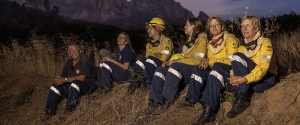
Many fynbos plants need fire to reproduce and ensure survival.
Geophytes, bulbs and corms thrive after fire and beautiful flower displays can be observed.
Although Fynbos is a fire-adapted system the frequency and time of the year a fire occurs determines if it was to the advantage or detriment of the ecosystem.
The intervals between fires must allow the slowest growing plant to flower at least three successive seasons. The Fynbos biome is located in the winter rainfall region. Fynbos growth take place during winter and spring. The most fires occur between October and May.
Only make a fire in marked areas where fires are allowed. Make sure the coals are cold before you leave the site.
If you observe a fire during your visit to the Cederberg, please notify the nearest tourism facility or phone the CapeNature emergency number.
Waste Management Strategy
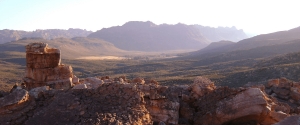
The Cederberg Conservancy does not have the benefit of municipal waste removal services. This resulted in uncontrolled small scale waste dump sites located on individual properties in the Cederberg Conservancy. This practice could pose significant threats to the health and well-being of the environment, residents and visitors, and could detract from the character of this beautiful Cederberg area. For these reasons the Cederberg Conservancy compiled and implemented a Waste Management Strategy.
See how you can assist with this project (download the attachment below)
Stewardship
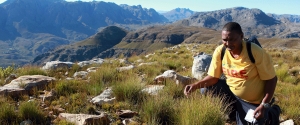
The Cederberg Conservancy is a partner in this initiative run by CapeNature. Stewardship refers to the wise use, management and protection of that which has been entrusted to us. Within the context of conservation, stewardship means wisely using natural resources that we have been entrusted with on our property, protecting important ecosystems, effectively managing alien invasive species and fires, and grazing or harvesting without damaging the veld.
The vision of the Stewardship Programme is threefold
- To ensure that privately owned areas with high biodiversity value receive secure conservation status and are linked to a network of other conservation areas in the landscape.
- To ensure that landowners who commit their property to a stewardship option, will enjoy tangible benefits for their conservation actions.
- To expand biodiversity conservation by encouraging commitment to, and implementation of, good biodiversity management practice, on privately owned land, in such a way that the private landowner becomes an empowered decision maker.
The Stewardship options that the CapeNature Stewardship Programme promotes include
- Contract Nature Reserves - Contract Nature Reserves are legally recognized contracts or servitudes on private land to protect biodiversity in the long term.
- Biodiversity Agreements - Biodiversity Agreements are negotiated legal agreements between the conservation agency and a landowner for conserving biodiversity in the medium term.
- Conservation Areas - Conservation Areas are flexible options with no defined period of commitment (includes conservancies).
The Cederberg Conservancy has to date signed ten Contract Nature Reserves, one Biodiversity and one Conservation Area agreement. These agreements have contributed about 170 000ha to conservation and the expansion of the Greater Cederberg Biodiversity Corridor.
SOB Data Collections
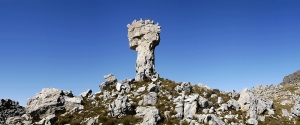
CapeNature launched its State of Biodiversity Programme to assess and monitor the state of biodiversity in the Western Cape in 1999. CapeNature has different monitoring and data collecting programmes that cover many different taxa with a particular focus on threatened species such as the Black Eagle breeding success and natural processes ranging from protea seedling regeneration after fires to monitoring frog populations in relation to global climate change.
Information on the distribution of plants and animals is stored in the CapeNature Biodiversity Database. This database houses taxonomic data and relationships for each taxon in the Western Cape. The database also holds distribution records for each taxon. Distribution data is not limited to CapeNature reserves and covers most of the province. Distribution data is obtained from a variety of sources: museum and herbarium specimens, photographs, audio recordings and observations, tissue samples, spoor & scats.
Visitors to the Cederberg Conservancy can help to contribute to the State of Biodiversity of the Cederberg by recording observations on a data sheet and submitting it on our Facebook page.
Open Days & Awareness
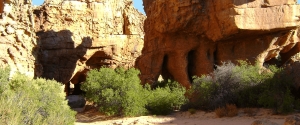
The Cederberg Conservancy hosts an annual Open Day to raise awareness among the farming community and to promote conservation initiatives.
An Open Day has been hosted every year since 1998 and a variety of topics have been covered including: Water conservation, Snake awareness, Indigenous fish, Rock art conservation, Spiders, Fossils, Geology of the area and Medicinal plants to name but a few. On different occasions we have had a live cheetah and black eagle to raise awareness of these magnificent animals.
The community has assisted with the planting of cedar seeds and saplings in the mountains and one year we picked up all the rubbish along the road from Algeria to Mount Ceder.
These awareness days are open to members of the public on condition that you book in advance.
Visit our Facebook page for news on upcoming events.
Cape Leopard Trust
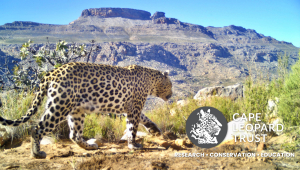
The Cape Leopard Trust (CLT) is an environmental NGO and non-profit, founded in 2004 and based in the Western Cape, South Africa. They facilitate and promote the conservation of biological diversity, with a focus on the leopard as a flagship species.
The leopard is the last large predator and member of the Big 5 to still roam free in the Western Cape. The species faces multiple threats, including limited and fragmented habitat, reduction in prey numbers, and high levels of conflict with people.
The CLT’s purpose and vision is to ensure the continued survival of leopard populations, to help secure their habitat and prey base, and to promote their coexistence with humans. To achieve this, they employ a three-pillar approach of research, conservation, and education. These three pillars operate in synergy within the CLT and in collaboration with communities, private landowners, and partner organisations.
The Cederberg is the birthplace of the CLT, and the partnership between the CLT and the Cederberg Conservancy has been ongoing since 2004. The CLT is indebted to many landowners and private properties in this region for invaluable support in their continued efforts to research and protect the greater Cederberg’s natural heritage.
For more information go
Follow the Cape Leopard Trust on socials
Accommodation
Sanddrif Holiday Resort
Sanddrif is situated on the farm Dwarsrivier, home of Cederberg Private Cellar, approximately 250 km north of Cape Town. Sanddrif consists of self-catering cottages and campsites with electricity points.
Activities

Overnight Hikes
The available huts on trails serve as shelters only and do not have beds. Hikers can sleep under the stars or in caves or carry a tent.
Conservation projects

Waste Management Strategy
The Cederberg Conservancy does not have the benefit of municipal waste removal services.

Cape Leopard Trust
The Cape Leopard Trust (CLT) was established with the primary objective to facilitate and promote research and conservation of the Cape’s predator diversity.

Open Days & Awareness
The Cederberg Conservancy hosts an annual Open Day to raise awareness among the farming community and to promote conservation initiatives.

Biodiversity & Wine Initiative
The Biodiversity & Wine Initiative is a partnership between the South African wine industry and the conservation sector.
About Cederberg Conservancy
-
The Cederberg Conservancy was constituted in 1997 as a voluntary agreement between landowners to manage the environment in a sustainable manner. It consolidates 22 properties in the central Cederberg as one of the core corridors of the Greater Cederberg Biodiversity Corridor and it is active through quarterly meetings and awareness days.
Visitors to the area can engage in bird watching or easy hikes to the Stadsaal cave and Elephant rock art. For the more adventurous visitor the Conservancy offers Mountain bike trails or overnight hiking trials that vary from one to five nights, depending on your level of fitness and ability.